November 13, 2026
Revenue leakage in healthcare almost never shows as a crazy line on a report. There's no single dramatic event, no line item that screams we lost $200,000 this year. It's a slow drip instead; a missed appointment here, a transposed policy number there, a statement that goes out by mail and is promptly ignored. Individually, each leak is easy to ignore. Added up across a year and they're the difference between a healthy margin and an at-risk bottom line.
That's what makes leakage one of the trickiest problems in revenue cycle management: it hides. A practice can be busy, clinically excellent, and working hard, but still watch an unsatisfactory cash flow. Practices named denials and appeals as their biggest leak (48%), followed by front-end errors (23%), then billing and collections (14%). In other words, most of the money leaks due to process failures before and after the claim is submitted.
The good news: these leaks are preventable process gaps, not irreparable damages in your cash flow. ,Whether you run a single location or a network spanning hundreds of sites, the leaks are usually the same, only the number of zeros changes.
Before the visit: the front desk leaks you can't see
Phone-only scheduling. If the only way to book an appointment is to call during business hours, then you're invisible to every patient who's researching and ready to schedule when they get home from their jobs. Online self-scheduling and registration is available 24/7 and captures demand at the moment it exists instead of hoping the patient remembers to call tomorrow. Across a multi-site group, that captured demand compounds at every location.
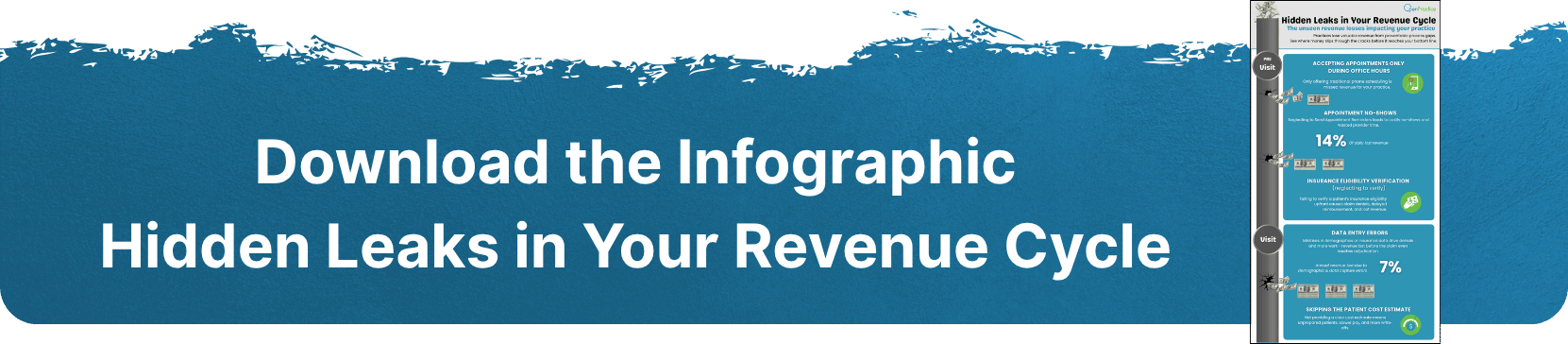
Appointment no-shows. No-show rates in the US run between 15% and 30%. An empty slot on your calendar is revenue you can't restock. The deeper cost is continuity: every missed visit is a break in the care relationship, and broken continuity is tied to worse outcomes and higher downstream costs. So, how do you reduce patient no-shows? Not with a policy taped to the front desk, but with reminders patients actually see. The solution is unglamorous yet highly effective: automated, multi-channel reminders (text, email, voice) on a consistent cadence. You can also offer easy self-rescheduling so a cancellation becomes a refill instead of a hole.
Skipped insurance eligibility verification. How do you verify insurance eligibility without adding work to an already-slammed front desk? You automate it. Coverage lapses, plans change, deductibles reset. And if you find out after you've delivered care, you probably find out via a denial. Does eligibility verification reduce claim denials? Absolutely. Inaccurate registration and eligibility oversight are the single biggest reason claims get denied (around 27%). Automatically-scheduled, real-time insurance eligibility verification at scheduling, and again at check-in, turns that future denial into a non-event before the patient ever walks in. In fact, some software can even search for missing and unknown coverage and fill in the missing pieces.
During the visit: small errors, expensive echoes

Medical billing errors that start at the keyboard. What are the most common medical billing errors? The humble ones: a misspelled name, a wrong date of birth, a fat-fingered member ID. It sounds trivial, but to a payer's automated system, a demographic mismatch is grounds for rejection before a human (or AI) ever sees the clinical content. The fix? Validate at the point of entry. Have patients use their phones or in-office scanners to scan in their IDs and prevent human typing errors. Inevitably, patients move, change phone numbers, change insurances. Demographic verification tools in your software can fill in any gaps and update antiquated data.
No estimate for the patient. A patient who isn’t expecting a bill is a patient who pays late, if they pay at all. Surprise balances get set aside, disputed, or written off. The best moment to collect cleanly has already passed. Give patients a clear, benefits-based estimate at or before check-in, and you flip the script. The bill stops being a shock and becomes an expected and planned payment. Even better is a point-of-service collection, the highest-yield moment you'll get.
After the visit: where cash flow goes to wait
Monthly claim batching. If claims only go out once a month, some sit for 30 days before they're even submitted. This ages your A/R before the payer even lays eyes on them, and bunches your denials into a monthly pileup instead of a consistent and manageable trickle. Submitting daily smooths your cash flow and surfaces problems quickly, while they're still fixable. Across a large billing operation, daily submission also keeps denial work from becoming a monthly fire drill.
Claim denials left unworked. A denial isn't a "no." It's a "not yet." But only if someone actually works it. Left sitting, it's just a silent write-off with extra steps. And they sit more often than you'd think: more than half of denied claims are never reworked. The fix is a system: capture every denial right off the remittance, sort by reason and dollar value, and assign them to be worked with the highest-value, soonest-to-expire appeals first. Across a multi-site group or billing company, a structured denial workflow is the difference between recovering that revenue and writing it off at scale.
Aging A/R without follow-up. Every charge in your A/R has a shelf life. The longer it sits, the less likely you are to ever collect it. Claims in your 90+ day bucket quietly turn into write-offs when nobody's chasing them. A worklist or report that easily displays aging claims by age and dollar value, with someone accountable for working it before the filing window slams shut prevents collectable revenue from becoming a write-off.
Secondary insurance never billed. When a patient has secondary coverage and the claim never goes out to that second payer, your revenue never arrives. It's one of the easiest leaks to miss because nothing bounces back: the primary pays, the balance looks "handled," and the secondary portion quietly evaporates. Coordination of benefits should be automatic. Flag secondary coverage at registration, then trigger the secondary claim the moment the primary remits. For practices carrying a lot of dual-coverage patients, that's a standing revenue stream that can easily be left behind.
Paper-only statements. How can billers improve patient collections? Start by looking at how the bill reaches the patient. Mailed statements are slow, expensive, and easy to ignore. Each one runs several dollars once you count printing, postage, and staff handling, and it often takes multiple mailing rounds before a balance is actually paid. Meet patients where they already are; send text and email statements with a one-tap payment link. You should also include the option to enroll in a self-service payment plan, making it faster and easier to pay collapses the distance between "you owe this" and "paid.”
The thread running through all of it
Look closely, and you’ll realize that these aren't ten separate problems; they're one problem wearing ten outfits. Every leak is revenue you already earned, slipping away because a step didn't get finished: the reminder you didn't send, the coverage you didn't verify, the denial nobody worked, the aged claim nobody chased, the secondary payer nobody billed. On top of that, the leaks feed each other. A shaky front end creates denials. Unworked denials age into A/R. Aged A/R quietly becomes a write-off. The first drop you ignore at the schedule shows up months later as a line on a write-off report.
None of these fixes require reinventing your organization. They just require seeing the gaps you may be blind to and adjusting your processes or workflows to close them one at a time.
FAQs
What is revenue leakage in healthcare?
Revenue leakage is money that is earned but never collected. It’s money owed for care already delivered that's lost to preventable process gaps like eligibility errors, denials, undercharging, or uncollected patient balances. Unlike bad debt, it's collectible revenue that quietly slips away across the revenue cycle.
How much revenue do practices lose to revenue leakage?
There's no single universal figure because revenue leakage hides in different places for every organization. But it tends to be concentrated in identifiable spots: a 2026 MGMA poll found practices' biggest leaks come from denials and appeals (48%), front-end errors (23%), and billing and collections (14%), meaning most leakage is traceable and preventable.
What is a good clean claim rate?
A clean claim rate is the share of claims accepted on first submission with no edits. Best-in-class billers target around 98%. Slipping much below 95% usually points to front-end data and eligibility problems driving avoidable denials and rework.
What is the cost to collect in healthcare?
Cost to collect refers to how much is spent to collect each dollar that's owed. It includes staff, billing software, statements, clearinghouse fees, and follow-up. It's typically benchmarked at just a few percent of net patient revenue. However, the more manual and paper-based your process, the higher it climbs.
What percentage of a medical bill is patient responsibility?
It varies by coverage plan, so there's no single number. But the patient's share has grown sharply. The average single-coverage deductible hit $1,886 in 2025; that’s up 43% over the decade. With about a third of covered workers facing deductibles of $2,000 or more, patient balances are now one of the largest (and hardest-to-collect) slices of practice revenue.
What is coordination of benefits (secondary billing)?
Coordination of benefits (COB) is the process that decides the order in which health plans pay when a patient is covered by more than one. One plan is designated primary and pays first, up to its limits; the secondary plan is then billed for eligible costs the primary didn't cover. It’s designed so the two plans together never pay more than the total charge. Secondary billing is simply submitting that second claim once the primary has adjudicated and sent its remittance. Getting COB right includes confirming which plan is primary at registration, then filing the secondary claim promptly.