Minerva: Behind the Scenes of OpenPM’s Medical Billing AI
September XX, 2026

Minerva is the AI assistant built into OpenPM. Here's a look under the hood, from the engineers who built her.
Most of the interesting stuff in software happens where you can't see it. Our team has spent the last few months rebuilding Minerva from the inside out, and we wanted to pull the curtain back and show you what she can actually do. "AI" gets stapled onto everything these days, and most of what wears the label just answers questions about your software. Minerva actually does the work inside it.
Fair warning: we an engineers, not marketers, so this is going to read like someone a little too excited about the thing we built. Grab a coffee.
Here's the problem Minerva is built for. Whether you're running the revenue cycle for a large practice or a book of client accounts, billing is fundamentally a volume problem; more claims, more denials, more follow-up, more people needed to keep it moving. Medical billing / RCM AI only earns its keep if it takes real work off that pile. So that's what we built her to do.
What Minerva actually does (medical billing AI that takes action)
Every action your team can take in OpenPM, including clicking through screens, entering data, running and reading reports, Minerva can now take too from a plain-language request. Ask her to find a patient, scrub a claim, post a payment, or build a report, and she does it.
She can do this because she has hundreds of discrete actions available to her today, and we're adding more just about every day. You never need to know they're there. You just describe what you need; she figures out how.
That's the line we'd draw between an AI that talks about revenue cycle management and one that actually performs it.
She shows her work (which matters more than it sounds)
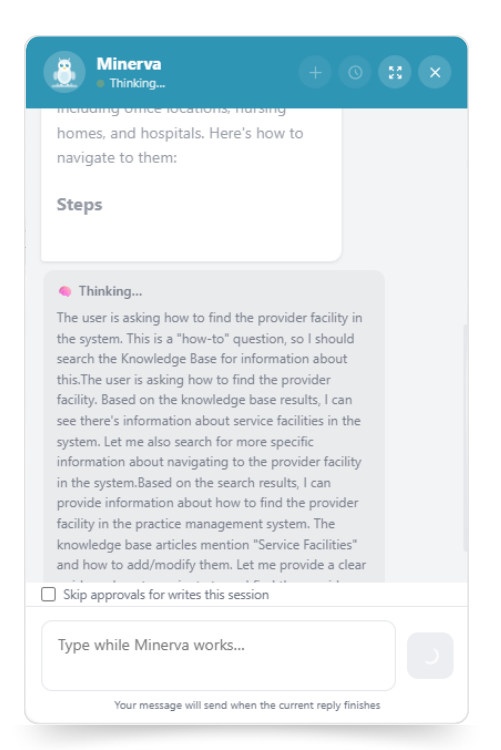
The first thing you'll notice is that Minerva tells you what she's thinking while she works. Ask her to do something, and you'll watch her reasoning unfold, step by step, before she lands on an answer.
We did that on purpose, even though it means you'll sometimes watch her think her way into a wrong answer. Here's why: AI isn't always right, and hiding that doesn't help anyone. When you can see how she got somewhere, you can catch the moments she misses, and every miss you catch is one we can fix. For an operation that has to stand behind its numbers, that visibility is the whole point.
She builds what she needs, on the spot
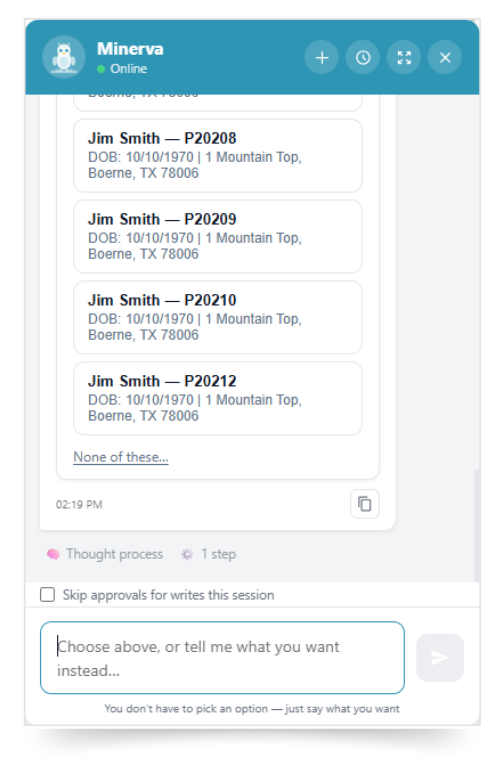
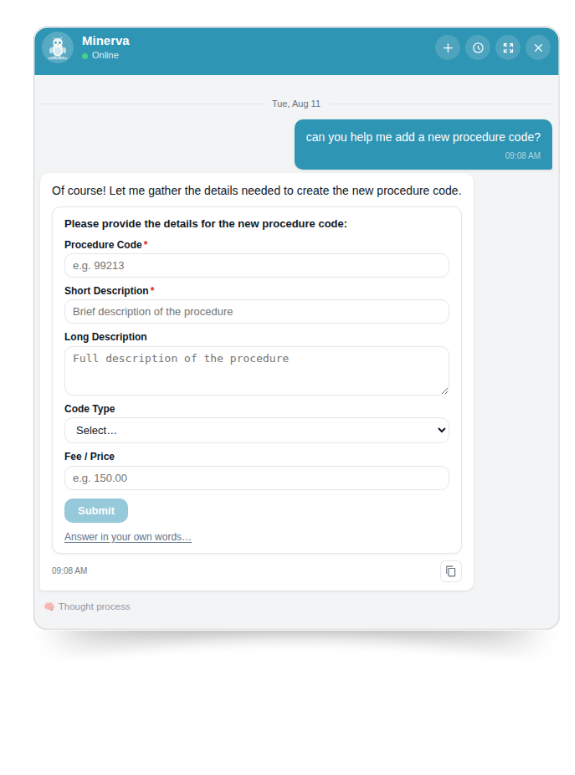
This one's our favorite. Minerva can generate the interface she needs, right inside your conversation, to finish a job.
For example, you ask Minerva to schedule an appointment, but leave out a few details. Instead of a typed back-and-forth conversation, she'll spin up exactly what she needs on the fly: a dropdown for appointment type, a calendar to pick the date, or a field for a note. Two patients named John Smith? She'll show you both and offer buttons so you can tap the right one.
You're always in control. Anything that changes a record in your system waits for your approval before it actually happens. Once you trust her with a routine, well-defined task, you can let that workflow run on its own. Want a human reviewing everything? That's the default. You decide how much rope she gets, task by task.
Tools, workflows, and automations: how the RCM AI actually works
Now, the part the whole team really nerds out about. Bear with a little vocabulary, we promise it pays off.
Each of those actions is what we call a tool. When you ask Minerva to find a patient named John Smith, she reaches for her "search patient" tool without you ever needing to know it exists. Tools are the building blocks.
Stack them together, and you get workflows, repeatable sequences for the work that matters most. We've already built workflows that scrub claims (checking them for errors before they go out). With AI insight layered on top, Minerva can draft reconsideration and appeal letters and untangle the adjustments hiding behind a patient or encounter balance. And soon you'll be able to build your own workflows. We're good at this, but you're the real expert on your own operation, and you'll build workflows we haven’t thought of yet.
Chain all this together and you get automations, which is where it gets a little magical. This is essentially Minerva working while you sleep. A charge management rule is a condition that you set to flag claims automatically. When one of these rules fires, she can launch the proper claim scrub and resolve what is found, without anyone at the keyboard. Now multiply that across your entire claim volume, or across every client you bill for. We’re talking about the difference between hiring to keep pace and freeing the team that you already have to focus on the work that needs human judgment. For an RCM company, that's margin.
A few things Minerva can do right now:
Check calendar availability and book an appointment in one breath.
Scrub a claim, fix the issue she finds, then create a rule so it never happens again.
Describe a report you want in plain language. Then watch her build it, save it, run it, and tell you what it means.
Post and edit charges and payments.
Our goal is to bring plain-language simplicity to some of the most complex corners of a practice management system.
Works with the EMR you already have
OpenPM is EMR-agnostic and plug-and-play, with 75+ EMR integrations, so Minerva works on top of the EMR already in use. You get serious financial sophistication and native automation without the cost, risk, and disruption of migrating to an all-in-one platform that you never really wanted.
What's on the workbench
We release daily, so here's the honest state of things.

Landing soon: Full parity between what you can do as a user and what Minerva can do. We expect to close the last gaps in the coming weeks. Also in the works is file input. Basically, paste a report or a chart note into the prompt, or pull one straight from the system, and let her analyze and act on it. And voice input is being developed. Typing is overrated; just talk.
Still prototyping (the ambitious stuff): Reaching beyond OpenPM to act in the world outside it. For example, submitting appeals, working inside payer portals, and storing the attachments payers ask for. Scheduling by phone is where a patient calls your reminder line and Minerva gets them on your calendar. Also, putting Minerva inside POPS™ (Patient Online Payments and Scheduling) to answer routine questions about scheduling and balances, so the simple, repetitive calls stop landing on your front desk.
See her in motion
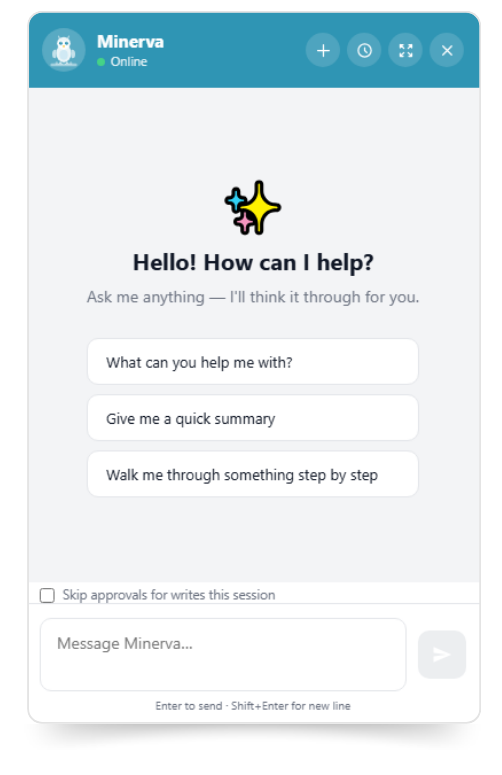
Minerva is a lot easier to understand by seeing her work versus reading about her. Request a demo and we'll happily show you Minerva running inside a setup like yours.
If there's something you wish she could do, tell us! A surprising amount of what you just read started with a customer's wish list.
None of this was a solo project. Dozens of people had a hand in it, including engineers writing and rewriting code, the folks who tested and broke every build on purpose so you wouldn't have to, and the support and implementation teams whose notes from real customer calls shaped what Minerva learned to do.
Stay tuned, because we're still just getting started!
Written by the OpenPM AI team.
FAQs About AI in Medical Billing
What is medical billing AI?
It's software that uses artificial intelligence to perform or assist with revenue cycle tasks such as eligibility, claim scrubbing, payment posting, denial follow-up, reporting, or scheduling. Minerva is our take on it: an assistant that doesn't just answer questions about billing, but carries out the work inside OpenPM from plain-language requests.
Can AI actually do the billing work, or does it just answer questions?
Minerva does the work. It performs real tasks inside OpenPM, including scrubbing claims, posting and editing charges and payments, building and running reports, checking availability, and scheduling. All these tasks run from plain-language requests.
Does AI replace medical billers?
No! And speaking as someone who built it, that was never the goal. Minerva takes the repetitive, high-volume work off your team's plate so your billers can spend their time on the exceptions, appeals, and judgment calls that actually need a human. She scales what a skilled biller gets through; she doesn't replace them.
Do we have to switch EMRs to use Minerva?
No. OpenPM is EMR-agnostic with 75+ EMR integrations. Minerva works alongside the EMR your providers already use rather than replacing it.
Can Minerva change our data without approval?
Only if you choose to let her. By default, anything that alters a record waits for your team's sign-off. You decide which routine workflows, if any, are allowed to run on their own.
How do you keep an AI that makes changes to our data secure?
There are three layers. First, the control that was already described: record-altering actions wait for human approval by default, and Minerva shows her reasoning at every step. Second, Minerva takes the user’s permissions into account, so it’s locked to only what the logged in user can do. Third, the platform underneath Minerva, OpenPM, is HITRUST e1 certified and maintains SOC 1 Type 2 and SOC 2 Type 2 certifications. All data is stored in centers that encrypt it at rest and in transit using SSL, IPSec, and AES. The full details are in our Privacy Policy and Terms of Service.